Is Your Salon CRM Actually the Problem?
Before replacing the system, separate an unclear process, uneven practice, missed configuration, and a real software limit.
A salon-owner investigation into whether recurring operational friction comes from process, training, configuration, workflow fit, or the software itself.
We keep fighting the system. Maybe the software is the problem.
That thought had begun to feel obvious. The front desk kept a spreadsheet beside the CRM. Staff entered some details twice. Notes were inconsistent. Reports took too long to assemble. A booking could be technically correct and still leave the wrong person discovering a problem at the handoff.
When the same frustrations appeared week after week, replacing the system started to sound less like a project and more like relief.
Then I tried to write down what the software had actually done wrong.
I had plenty of symptoms. I did not yet have a cause.
You cannot tell from the symptom alone. Define one required workflow and result, watch the task happen, make the rule clear, give staff a fair chance to perform it, verify the relevant configuration, and observe repeated cases. If the problem diminishes, process, practice, or configuration was part of the cause. If a measurable limitation remains because the software cannot represent or execute the required work, continuing toward replacement becomes rational.
The question in my notes became:
How do I know whether my CRM is actually the problem?
The symptoms were real. They just were not diagnoses.
I began with the spreadsheet because it seemed like the clearest evidence. If the CRM were doing its job, why would the team need another file?
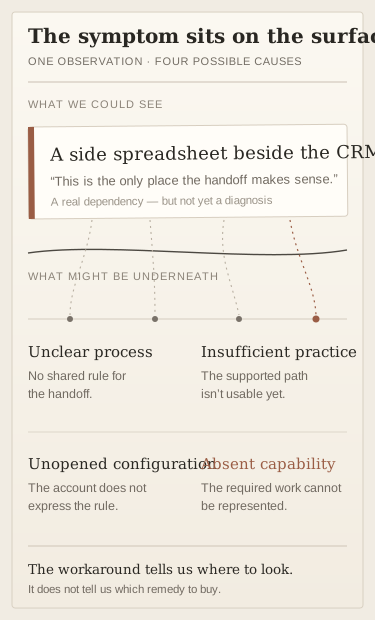
But the spreadsheet was doing several jobs at once. One column reminded the receptionist about a handoff that nobody had formally assigned. Another corrected a naming convention that different staff interpreted differently. A third tracked something the team believed the CRM could not show. The file was not one workaround. It was a stack of compensations that happened to share a grid.
The same was true of duplicate entry. Sometimes a staff member entered information twice because the agreed process required two records. Sometimes nobody knew which record was authoritative. Sometimes a report pulled from one place but the daily workflow used another. Sometimes the team had never found the relevant setting. And sometimes the software really did not connect the records the business needed connected.
That made the visible symptom less decisive, not less important.
Primary studies of electronic health-record workarounds helped me see why. Researchers have observed similar-looking paper and computer workarounds serving different purposes: memory, awareness, efficiency, local goals, or compensation for a missing electronic path. Other studies grouped contributing conditions across people, tasks, organizations, and technology. These are healthcare and industrial cases, not evidence about the prevalence of workarounds in salons. Their useful lesson was narrower: the artifact itself did not identify the remedy. (Flanagan et al., 2013; Boonstra et al., 2021; Blijleven et al., 2017; Outmazgin, Soffer, and Hadar, 2020; accessed July 25, 2026.)
I stopped asking, “Why are they using a spreadsheet?” as though there could be one answer.
I started asking, “What job is each part of this spreadsheet doing?”
Watching one handoff changed the question
My first instinct was to collect opinions. I could ask the team what was broken, list the complaints, and look for the feature mentioned most often.
The answers were useful, but they described different moments. One person remembered the original booking. Another saw the client arrive. Someone else corrected the report days later. Each was telling the truth from a different point in the work.
So I chose one recurring task and watched it from beginning to end.
I noted what started it, who touched it, what they needed to know, where they paused, what they wrote outside the system, and what had to be corrected later. I paid particular attention to handoffs because that was where private certainty became shared work. A field could look complete to the person who entered it and still fail the next person who needed to act.
Official usability guidance from the U.S. General Services Administration describes observing people attempting representative tasks and using realistic scenarios rather than relying only on what users say they do. NASA’s root-cause guidance similarly distinguishes symptoms from underlying causes and combines observation, interviews, and document review when evaluating causal explanations. Those sources come from government digital-service and safety contexts, not salon operations. I used the method, not their domain conclusions. (Digital.gov usability testing; NASA Root Cause Analysis Overview, 2018; accessed July 25, 2026.)
Observation did not make the staff explanation irrelevant. It gave the explanation somewhere to attach.
When someone said, “The CRM makes me do this twice,” I could now ask which two writes they meant, what each one controlled, and what happened when either was skipped. When someone said, “There is a setting for that,” I could ask whether the setting changed the real handoff or only changed what appeared on one screen.
I was no longer trying to decide whether the team or the software was right. I was trying to locate the point where the required result stopped being reliable.
We could not test a process we had never agreed
The next surprise was uncomfortable: two competent people described the “correct” workflow differently.
One believed the receptionist owned the final confirmation. Another believed the service provider should resolve it after seeing the note. A manager thought the exception required approval. The person working the desk thought it was an ordinary judgment call.
Until then I had expected the software to settle the argument. But a system could not faithfully enforce a rule the business had not chosen.
I wrote the intended task in plain language:
- what event starts the work;
- who is responsible at each handoff;
- which information must be available;
- what ordinary completion looks like;
- which exception matters;
- what result the client and the business should receive.
This was not yet the larger question of which practices every location or role should standardize. That comes next. I needed only enough agreement to test one recurring failure.
The absence of agreement changed how I read the symptoms. Inconsistent notes could reflect an impractical screen, but they could also reflect five private definitions of a useful note. A delayed report could reflect slow software, but it could also reflect a metric whose cutoff, exclusions, or owner had never been decided. A missed handoff could reflect a missing alert, but it could also reflect a responsibility that existed only in someone’s memory.
The software might still be limiting. I just could not demonstrate that by asking it to implement several incompatible versions of the work.
Showing the feature was not the same as making the task workable
Once the intended path was clear, I looked at training.
I nearly made the opposite mistake here. If the software had a help article and the staff had attended onboarding, I was tempted to call any remaining bypass an adoption problem.
But “the feature was shown” answered a smaller question than “the person can complete the task under real conditions.”
A receptionist might understand the screen and still lack the permission needed during a busy shift. A service provider might know the official path but receive the relevant information too late. A manager might be able to correct the record on a desktop while the person responsible at the moment works from a phone. A rare exception might never have appeared in training.
The UK Health and Safety Executive’s human-factors guidance separates job/task factors, individual factors such as competence, and organizational factors. It warns against considering those elements in isolation. The guidance is written for workplace safety, not CRM selection, but the distinction was useful: competence could not be evaluated apart from the conditions in which the work had to happen. (HSE introduction to human factors; HSE HSG48, accessed July 25, 2026.)
So I gave the people responsible a fair chance to perform the agreed task. That meant role-appropriate access, a realistic example, the important exception, and time to practise the path—not a reminder that the feature existed.
If the friction diminished, training or adoption conditions had been part of the cause. That did not prove the software was ideal. It showed that replacement was not the only available remedy for that symptom.
If competent use still produced the same failure, the diagnosis moved elsewhere.
This was also where an earlier question about why capable employees stop using software became relevant. A workaround can carry knowledge about timing, access, incentives, or exceptions. Removing it before understanding that knowledge can hide the signal without repairing the work.
The setting existed. That did not settle the question.
Next I checked configuration.
At first this felt mechanical: find the feature in current official documentation, compare it with the account, switch it on, and declare the gap closed.
That was still too quick.
Documentation could establish intended behavior, available settings, permissions, and stated scope for the exact product, plan, and region. It could not show whether the configured path was practical for this salon’s roles, devices, timing, and exceptions. A setting could exist and still require a sequence that made the handoff unreliable. A capability could work for the ordinary case and fail the case that created the measurable risk.
The reverse mattered too. A team could conclude that the software lacked a function simply because the relevant permission, status, template, or workflow rule had never been configured.
So I kept two records separate:
- what the current official documentation said the product was intended to support;
- what happened when the configured account was used for the real task.
Neither record was enough alone. The first prevented me from calling an undiscovered setting a structural limitation. The second prevented me from treating a documented feature as proof of practical fit.
This article does not evaluate a named product, plan, or account. No product-specific documentation or configuration was tested for it. Any actual salon diagnosis would need those current records.
The controlled test was smaller than a replacement project
By then I had five plausible cause classes in my notes:
- unclear process: there was no shared rule for the task or its exceptions;
- training or adoption failure: the supported path existed, but people could not or did not perform it reliably in real conditions;
- configuration failure: the product could express the requirement, but the account was not set up to do so;
- workflow mismatch: the product supported a related path, but the required steps or exceptions created persistent, impractical friction;
- structural software limitation: the product could not represent or execute a required part of the work.
They were not five boxes competing for one label. Several could be true at once.
I needed a way to see which explanation changed the result.
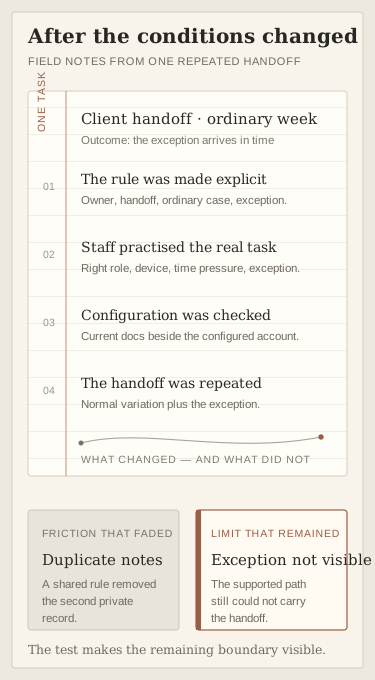
I chose one recurring task and one observable outcome. I recorded the current path without correcting it. Then we agreed the intended rule and one legitimate exception, gave the responsible people a realistic practice opportunity, checked the relevant configuration against current documentation, and repeated the task in ordinary conditions.
I did not set an invented universal count. A daily task and a rare financial exception do not need the same observation window. One clean run would not show that the result was stable; endless observation would postpone a decision forever. The useful boundary was enough repetition to include normal variation and the exception that mattered.
For each run, I kept the notes modest:
- where the task paused;
- what was entered twice;
- what had to leave the system;
- what the next person could not see;
- what was corrected later;
- what consequence followed.
The method resembled current-state workflow assessments reported in health-information research, where investigators considered workflow requirements, workarounds, interface issues, and training gaps together. That study concerned one healthcare facility after an electronic-record transition, so it does not validate this test for salons. It supports the more limited idea that several evidence streams can be examined together rather than collapsed into one complaint. (Watson et al., 2023; accessed July 25, 2026.)
The problems divided instead of disappearing
I had expected the test to produce a verdict: either the staff needed to change or the software did.
Instead, I realized the useful result could be mixed.
If duplicate entry diminished after we agreed which record was authoritative, that would be evidence that the process had been part of the problem. If notes became more consistent once their purpose and minimum content were clear, practice had contributed too. If a report became available sooner after the configuration matched the reporting responsibility, the original complaint would no longer belong entirely to the software.
But suppose one handoff still failed under the legitimate exception. The responsible person followed the agreed path. Access and practice were adequate. The documented settings had been checked. The system still could not represent the condition the next person needed to see without an external note and later correction.
That would not prove the entire product was wrong for the business. It would identify a narrower boundary with a consequence.
This kind of mixed result would be more useful than assigning blame. Process correction would remove noise from the diagnosis. Practice would show what competent use looked like. Configuration would establish the product’s intended path. What remained could then be described without turning every earlier frustration into software evidence.
The reverse outcome would have mattered just as much. If the friction had largely disappeared, replacing the software for that reason would have been hard to defend. A new product might still be desirable for other reasons, but this symptom would no longer carry the argument.
“Better software” was not an operating outcome
Once a limitation remained, I felt ready to make a requirements list.
The first version said things like “better reporting,” “easier notes,” and “fewer workarounds.” It sounded sensible and would have been almost impossible to test.
So I returned to the task:
- Who needs the result?
- At what point in the work?
- Under which ordinary and exception conditions?
- What should be visible or possible?
- What measurable consequence should stop occurring?
- What result would be acceptable?
The answer might be: the person receiving a client handoff can see the agreed status and exception before acting, without checking a side spreadsheet, and the later correction no longer occurs. Or: the owner can produce the defined weekly report from the authoritative records by the agreed time without reconciling two privately maintained totals.
Those statements were less exciting than a feature wishlist. They were also testable.
The operating outcome did not dictate a product. It gave any remedy—process, training, configuration, supplement, or eventual replacement—the same condition to meet.
It also prevented a polished demo from changing the subject. A candidate could show an impressive feature and still fail the exact task that justified the project.
The replacement standard became narrower—and stronger
I would now continue toward replacement evaluation only when four things were documented:
- The required workflow and operating result are explicit. The business can state the task, responsible roles, important exception, consequence, and acceptable outcome.
- The people responsible can follow the agreed process consistently under realistic conditions. They have appropriate access and a fair practice opportunity.
- Relevant configuration and current documented behavior have been checked. An overlooked setting or permission is not being mistaken for a missing capability.
- A measurable limitation persists across repeated observations. The product cannot represent or execute something the required workflow depends on, and the consequence remains material.
If one condition was missing, I would record the result as unresolved.
That was not a scientific score or a guarantee that replacement would succeed. It was a way to stop converting uncertainty into certainty. A persistent capability boundary made continued replacement evaluation rational. It did not identify the right new system, prove that the business was ready to implement one, or show that migration would be safe.
If replacement later became the rational path, I would also need to ask what client and business information must survive the move. But that was not the next decision. I still had to define how the future operation should work.
The next question was about the salon, not the vendor
I began with a broad accusation: the salon kept fighting the system, so the system must be the problem.
The frustration was valid. The conclusion had arrived too early.
After following one task, the causes became more precise. Some friction belonged to an unclear rule. Some belonged to practice and access. Some belonged to configuration. One part could remain as a real workflow mismatch or structural capability limit.
That did not make the software innocent or the team responsible. It made the remedy testable.
The most useful result was not “keep” or “replace.” It was a record of the required workflow, what changed under controlled conditions, what consequence remained, and what any remedy would have to achieve.
Before comparing products, the next question in my notes was:
Which parts of this work should become a shared standard, and which exceptions must remain flexible?
Sources and limitations
This article was checked against official human-factors and research guidance and primary studies accessed July 25, 2026:
- UK Health and Safety Executive: Introduction to human factors and HSG48: Reducing error and influencing behaviour
- NASA Goddard: Root Cause Analysis Overview
- Digital.gov: Usability testing
- Boonstra et al.: Persisting workarounds in Electronic Health Record System use
- Watson et al.: Current State Workflow Assessment following an EHR transition
- Flanagan et al.: Paper- and computer-based workarounds
- Outmazgin, Soffer, and Hadar: Workarounds in Business Processes
- Blijleven et al.: Workarounds Emerging From Electronic Health Record System Usage
Most empirical studies cited here concern healthcare information systems, and one concerns a large industrial organization. They show why a workaround may have several explanations; they do not establish how common any cause is in salons or whether a particular intervention will work.
The salon scenario and test outcomes in this article are illustrative. No salon task was observed for this article. No salon owner or staff member was interviewed. No named CRM, plan, account configuration, or vendor capability was tested. The controlled test and four-condition decision standard are an evidence-bounded editorial synthesis, not a validated diagnostic instrument. A real decision requires direct observation, local interviews, current official product documentation, and the salon’s own consequence data.
Visaxa Research examines operating problems, evidence, failure conditions, and the questions a salon should resolve before choosing software.
Visaxa Research studies what actually breaks inside service businesses — scheduling, staffing, payroll, retention, operational systems, and scaling — and turns field observations into practical frameworks for owners.