Your Salon Software Problem Is Real. How Much Change Does It Justify?
Once the cause is understood, the smallest fix is not always the safest choice—and replacement is not automatically the best one.
How a salon owner can choose whether to accept, repair, supplement, renegotiate, or replace software by comparing future operating burden, transition risk, evidence, and reversibility.
For weeks, the salon owner had been trying to answer one question: was the software actually wrong for the business?
Now she had a narrower answer. The disputed appointment behavior was documented, repeatable, and incompatible with the salon’s required closeout. The last investigation had separated a fit boundary from a defect claim.
I expected the remedy to become obvious once the cause was clearer.
It did not.
This is a constructed salon case, not a Visaxa test or an observed result in any named product. It begins after diagnosis and asks a different question: how much change does one real limitation justify?
First remove every response that cannot reliably meet the required outcome. Then compare only the viable responses by their future operating burden, transition burden, uncertainty, risk, and reversibility. The right answer is not necessarily the smallest visible change or the largest replacement. It is the adequately evidenced response with the lowest credible prospective burden.
The smallest change looked safest
The owner’s first idea was to leave everything alone.
Checkout already worked. The appointment simply needed a second status action. The extra step took seconds. Compared with a new contract, another tool, or a migration, accepting the workaround looked almost costless.
Then she stopped timing one click and started following the work it created.
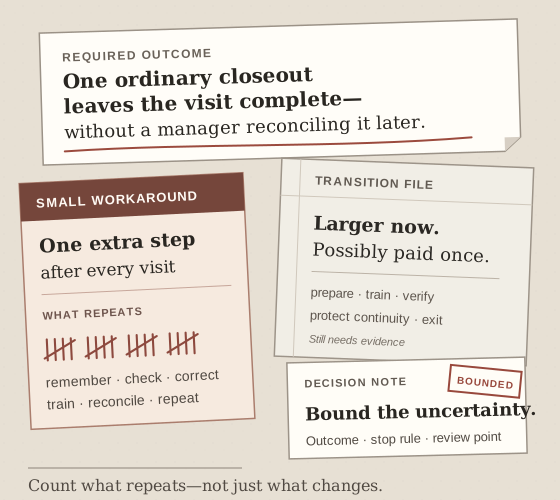
Someone had to remember the step on every relevant visit. A manager had to find the missed ones. Reports could remain incomplete until the correction. Training material had to preserve the exception. Every future employee had to learn why “paid” did not necessarily mean “finished.”
The visible change was tiny. The burden repeated.
That replaced the first mental model:
Small intervention and small future burden are not the same thing.
HM Treasury’s appraisal guidance uses business as usual as a benchmark and compares options against defined objectives, costs, benefits, and risks. It is public-sector guidance, not salon-software advice. The useful principle here is narrower: doing nothing is still an option with future consequences, not a zero-cost absence of choice. (The Green Book 2026, updated February 5, 2026; accessed September 30, 2026.)
The outcome became the first filter
The owner rewrote the requirement without naming a product or remedy:
After an ordinary visit is closed, the appointment, payment, and operating record should be complete without a manager reconciling them later.
That sentence changed the comparison.
“Remind the team to do the second action” did not reliably meet it. Nor did a cheaper plan, a nicer report, or a promise that the behavior might change later. Those ideas could be easy or inexpensive and still fail the required result.
The plausible response set was broader than “stay or switch”:
- accept the current behavior and its operating cost;
- repair a local setup if a supported repair exists;
- change plan or contract conditions if entitlement is the boundary;
- add a tool or integration;
- negotiate or escalate for a documented recovery;
- replace the system.
This was not a menu where every choice deserved a score. A response that could not meet the requirement was out. An unknown response stayed unknown until evidence changed it.
The Green Book makes the same structural distinction in its own field: an option that fails the stated objectives cannot become the preferred answer merely because it looks economical. That does not prove which salon remedy will work. It supports putting adequacy before comparison.
The add-on moved work instead of removing it
An integration seemed more proportionate than replacement. It might connect the two events without forcing the team through another migration.
But the owner’s next page filled quickly:
- another subscription or supplier relationship;
- another connection that required testing and support;
- another place where timing or data could diverge;
- an owner for failures between the two systems;
- a decision about which record remained authoritative.
None of those burdens proved that an add-on was wrong. They showed that “supplement” was not automatically the modest option.
GOV.UK guidance on integrating and adapting technology notes that integration can reduce disruption while also requiring coordination, testing, skills, dependency management, and continuing support. That scope is government technology, not salon operations. It supports checking these burdens; it does not predict the outcome of a salon integration. (Integrate and adapt technology, updated July 7, 2025; accessed September 30, 2026.)
The question therefore changed from “Can another tool connect this?” to:
If it connects this, what continuing work and dependency does it create?
Replacement had a different kind of weight
The owner then gave replacement the same treatment.
It could remove the designed-fit boundary. It could also require data preparation, migration checks, staff retraining, client continuity work, parallel verification, and a credible way to leave the old system.
That evidence did not need to be rediscovered here. The exit inventory defined what had to survive. The exit-readiness investigation established why an export button did not prove a workable exit.
U.S. GAO cost guidance includes interfaces, training, transition, infrastructure, and services in lifecycle estimates; a later GAO review also describes modernization itself as carrying operational and cost risk. Both sources concern government systems, not salons. They support counting transition work that a subscription-price comparison can hide. They do not supply a salon migration estimate. (GAO Cost Estimating and Assessment Guide; Legacy IT Systems Modernization, accessed September 30, 2026.)
The two burdens now sat beside each other:
- operating burden: what the salon must keep doing if the response remains in place;
- transition burden: what the salon must do, risk, and verify to make the response real.
Staying concentrated burden in the future routine. Replacing concentrated burden around change. Supplementing could create both.
Money already spent could not make the next result better
The owner had paid for setup, training, and months of subscription. Leaving felt like admitting those investments had been wasted.
But staying could not recover them either.
Only consequences that could still change belonged in the next decision: a remaining contractual payment, an avoidable renewal, future manual work, transition cost, or future risk. The time and money already irreversibly spent did not make an inadequate response more capable.
The Green Book explicitly separates sunk costs from future appraisal. Experimental research by Arkes and Blumer also documents the general tendency to continue because money, effort, or time has already been invested. Neither source decides this salon’s case. Together they explain why “we have already put too much into this system” is emotionally powerful but not evidence that staying will meet the requirement. (Arkes and Blumer, “The psychology of sunk cost”, 1985.)
Unknown did not mean equal
The owner still lacked one important fact: could a bounded integration meet the closeout requirement without creating a second operational truth?
She did not assign it a hopeful score. She wrote UNKNOWN.
Nor did she freeze the whole decision. The unknown was specific enough to test.
The proposed trial had to state, before it began:
- the required result;
- which ordinary cases would be observed;
- which record would be treated as authoritative;
- what evidence counted as success;
- what failure or reconciliation work would stop the trial;
- who owned the review;
- when the temporary arrangement expired or escalated.
GOV.UK’s Test and Learn guidance recommends targeting critical assumptions and agreeing how evidence will inform a decision before the test. It does not prescribe a salon trial length or success threshold. Those remained business decisions, not numbers to invent. (Test and Learn, updated May 15, 2026; accessed September 30, 2026.)
That replaced another tempting model:
A trial is not a delay if it has a decision rule. A workaround without an expiry can become the decision by accident.
The decision record became shorter than the investigation
The final page did not contain a weighted feature score.
It contained six lines:
- Required outcome: ordinary closeout leaves the relevant operating records complete without later reconciliation.
- Eliminated: acceptance and reminders, because they preserve the recurring control failure.
- Still viable: a bounded supplement test and replacement evaluation.
- Current evidence: the supplement is reversible but unproven; replacement may remove the fit boundary but carries material transition and exit burden.
- Decision: test the narrower response under predetermined evidence and stop conditions.
- Escalation: if the test creates duplicate truth, misses the required result, or cannot be supported reliably, reopen replacement rather than extend the workaround indefinitely.
That was not a universal recommendation to try an add-on first. In another case, the supplement might already be disproved, the contract might make recovery impossible, or the consequence of failure might make a trial unacceptable. The method chose no favourite intervention.
It made the reasoning inspectable.
The question worth copying into an AI or search tool became:
We know what is wrong with our salon software. How do I decide whether to work around it, add another tool, negotiate, upgrade, or switch?
The answer was no longer “choose the smallest change.” It was:
Keep only the responses that can meet the required outcome. Among those, choose the adequately evidenced response with the lowest credible future burden at an acceptable level of risk and reversibility. If a material uncertainty can be tested safely, bound the test before it begins.
If replacement became that response, a new question opened—and this article stopped before answering it:
If replacement is the decision, how do we retire the old system without losing evidence, access, or operational continuity?
Sources
- HM Treasury, The Green Book 2026, updated February 5, 2026; accessed September 30, 2026.
- GOV.UK Service Manual, Choosing technology: an introduction, accessed September 30, 2026.
- GOV.UK, Integrate and adapt technology, updated July 7, 2025; accessed September 30, 2026.
- U.S. Government Accountability Office, Cost Estimating and Assessment Guide, GAO-09-3SP, March 2009; accessed September 30, 2026.
- U.S. Government Accountability Office, Legacy IT Systems Modernization, GAO-25-107795, 2025; accessed September 30, 2026.
- Hal R. Arkes and Catherine Blumer, “The psychology of sunk cost”, 1985.
- GOV.UK, Test and Learn, updated May 15, 2026; accessed September 30, 2026.
Visaxa Research examines operating problems, evidence, failure conditions, and the questions a salon should resolve before choosing software.
Visaxa Research studies what actually breaks inside service businesses — scheduling, staffing, payroll, retention, operational systems, and scaling — and turns field observations into practical frameworks for owners.