There Is No Best Salon Software Until You Know What Must Pass
Why the useful comparison starts after your requirements—and gets smaller with every honest test.
A salon-owner investigation into comparing software with requirements, evidence, elimination gates, and a defined cost case instead of a universal ranking.
I thought I needed a Top 10 list.
There were too many salon systems, too many feature pages, and too many tabs open. A ranking seemed like the sensible shortcut: let someone else compare everything, take the highest score, and move on.
Then I tried to use one of those scores for our salon. I could see what had been counted. I could not see why those things had been given that importance—or whether the reviewer had cared about the same failures I cared about.
Compare salon software only after writing your requirements as pass conditions. Eliminate any candidate that fails a non-negotiable condition. Treat missing evidence as unknown, not as a partial pass. Compare price and preferences only among the candidates left. The result is not the best salon software in general; it is a shortlist that fits one salon’s documented needs.
The list had answered someone else’s question
My first mistake was subtle. I thought a ranking was a comparison. It was really a bundle of decisions already made for me: which features counted, how much each mattered, and which uncertainty was acceptable.
A high score could reward a feature we would rarely use. A lower score could punish a system for omitting something outside our operating model. Neither number told me whether reception could handle a real correction, whether our locations could share the right records without sharing the wrong permissions, or whether we could leave later with the business intact.
The question stopped being “Which product has the most?” It became “What must be true for our salon?”
Five salons could choose five different winners
I tested that change with five fictional salons.
One was hiring quickly and needed the next staffing threshold to remain workable. One had several locations and cared about what stayed shared and what stayed local. One relied on flexible staff patterns. One would not accept a system without a credible exit route. One needed financial records to reconcile under its own definitions.
Give all five owners the same product list and they could remove different candidates first. Their winners would differ without any of them being irrational.
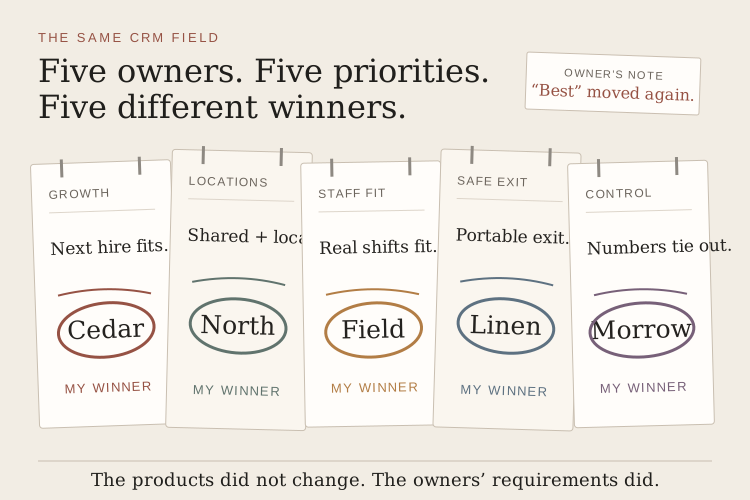
That was when “best” began to look like an incomplete sentence. Best for which boundary, which operating constraint, which evidence threshold, which cost case, and which exit requirement?
The requirements did not add points. They removed candidates.
I had expected to turn our requirements into a weighted score. But some requirements did not behave like preferences.
If a system could not represent a necessary staff or location rule, a beautiful interface did not compensate. If a critical report could not be reconciled, extra marketing tools did not make the number trustworthy. If the exit path remained unverified, a large feature total did not make the commitment reversible. The earlier exit-readiness investigation shows why a visible export route is only the first part of that check.
These were gates. A failed non-negotiable removed a candidate. A preference helped choose among survivors.
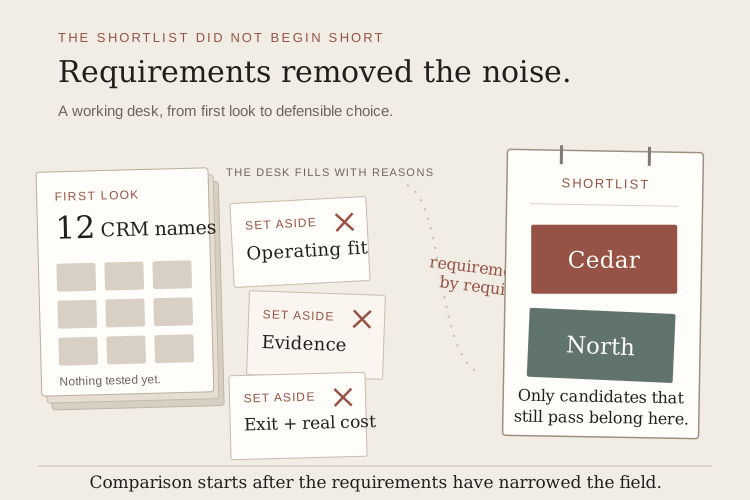
The matrix got smaller as it became more useful.
A checkmark was not the same as a pass
The next problem appeared when I tried to fill in the gates. Vendor pages had plenty of checkmarks. I wanted to copy them across.
Then the evidence stopped matching the questions.
A feature page could say that a function existed. It could not show that our staff could complete the failure case we cared about. A pricing page could show a current plan and fee structure. It could not calculate our total without our locations, staff, volume and add-ons. An API page could describe connected records. It could not prove that an owner-facing export preserved those connections.
Official pages from Square and Vagaro make the narrower point visible: displayed prices and available functions can vary with plan, location, bookable calendars, transaction type and add-ons. That is not evidence that either product fits or fails this salon. It is evidence that the salon scenario has to be defined before the numbers become comparable. (Official sources checked August 2, 2026; see Sources.)
I began matching evidence to each claim:
- official documentation for a documented capability;
- official pricing for a dated cost input;
- official terms for a contract or exit condition;
- a sample output for what an export actually contains;
- an observed salon test for whether a required workflow survives real conditions.
The checkmark now meant only “the vendor says this exists.” A pass required evidence that answered our exact requirement.
Unknown had to remain visible
At first I wrote “probably” beside missing evidence. That kept more candidates in the table and made the research feel less stalled.
It also quietly converted uncertainty into approval.
I replaced every “probably” with UNKNOWN. If the unknown concerned a preference, it became a question for a demo. If it concerned a non-negotiable requirement, the candidate could not enter the shortlist until the evidence arrived.
UNKNOWN was not a criticism of a product. The documentation might have been incomplete, the feature might have required a different plan, or I might have looked in the wrong place. But the salon would still be relying on something it had not established.
That distinction made the matrix less confident and more honest.
The cheapest option changed when the salon changed
I also wanted one clean monthly-price column. The official pricing material made that difficult for a good reason.
Selected official pages show examples of charges or plan differences tied to locations, bookable calendars, payment methods, message volumes and add-ons. Those pages are useful inputs, but they are volatile and scenario-specific. They do not produce a universal total.
So I stopped asking “What does it cost?” and wrote down a case: number of locations, bookable staff, expected payment mix, required add-ons, implementation work, duplicate work during transition, and the cost of leaving.
The lowest subscription could still be the lowest total. It simply had to earn that conclusion inside the same operating case as every other candidate.
The shortlist was smaller than the ranking—and more defensible
By the end, I had not found the best salon software. I had something more useful.
Each remaining candidate had passed the same non-negotiable requirements. Each pass pointed to dated evidence. Unknowns were still visible. Price referred to one declared salon scenario. Preferences could now decide among survivors without hiding a critical failure.
The original Top 10 list had reduced effort by making decisions out of sight. The shortlist reduced regret by making the decisions inspectable.
It also revealed the boundary of this comparison. Documentation could show that a candidate deserved a closer test. It could not prove that our records, relationships, notes, appointments and balances would actually survive a move.
That left the next question in my notes:
If a candidate passes on paper, how will I prove that the migration preserved what the business needs?
Sources
- Square, Appointments Pricing & Plans, accessed August 2, 2026.
- Vagaro Support, Manage Your Vagaro Subscription, updated April 10, 2026; accessed August 2, 2026.
- Vagaro Support, Add a New Multi-Location, updated March 27, 2026; accessed August 2, 2026.
- Fresha Help Center, Export Your Client List, accessed August 2, 2026.
- Square Developer, Customers API overview, accessed August 2, 2026.
- Square, General Terms, updated June 1, 2026; accessed August 2, 2026.
Visaxa Research examines operating problems, evidence, failure conditions, and the questions a salon should resolve before choosing software.
Visaxa Research studies what actually breaks inside service businesses — scheduling, staffing, payroll, retention, operational systems, and scaling — and turns field observations into practical frameworks for owners.