How to Pressure-Test Salon Software Claims Before You Buy
A confident answer is not yet decision evidence. Match every material claim to the source, conditions, artifact, and observable result your salon actually needs.
A salon-owner method for checking software vendor claims against official documentation, sample outputs, real task scenarios, contract limits, and visible unknowns.
I thought an official answer would settle it.
We had one requirement that mattered enough to affect the purchase. The vendor's page said the capability was included. The demo looked smooth. Several reviews sounded reassuring.
Then I tried to write the decision beside the evidence. The sentence “included” no longer felt complete. Included in which plan? For which role? Under what configuration? Would it produce the result our salon needed, or only something that looked similar in a demonstration?
That changed the question from “Do I trust this vendor?” to “What would make this particular claim safe to rely on?”
A vendor claim becomes useful decision evidence only when it matches a precise salon requirement. Record the source, date, product and plan, relevant conditions, expected result, observed artifact or test, and remaining limitation. Then mark the claim supported, conditional, unknown, or contradicted. An official page can support what is documented; it does not by itself prove the salon outcome.
The reassuring answer contained an unfinished sentence
The claim we were examining was deliberately ordinary: everything you need is included.
At first, that sounded broad enough to be reassuring. Under inspection, it was too broad to evaluate.
I rewrote one part of our need as an operating result. The receptionist in the appropriate role must be able to complete a defined client task, including one legitimate exception, without maintaining a second private record. The next person must be able to see the agreed result before acting.
Now “included” had something to answer.
The rewrite did not assume that the product would fail. It removed several easy substitutions. A related feature was not necessarily the required workflow. Administrator access was not necessarily front-desk access. A screen shown in a demo was not necessarily an output the salon could retain. A normal case did not settle the exception that had made the requirement important.
The first improvement was therefore not more research. It was a smaller claim.
An official source could be genuine and still answer the wrong question
I had been treating evidence as a ladder: a vendor page at the top, reviews somewhere below, and a sales answer filling any remaining gap.
That model failed because the sources had different jobs.
Current official documentation could establish what a vendor currently documents, within the product, plan, region, role, configuration, and conditions named on the page. It could not prove that our staff would complete our task successfully. A sample output could show what one inspected file contained. It could not prove that every relationship we cared about would survive. A demonstration could show observed behavior under prepared conditions. It could not establish long-term reliability. Contract language could establish a written obligation or exclusion. It could not prove how a workflow behaved.
The evidence was not weak simply because it was incomplete. It was weak only when I asked it to prove more than it contained.
This distinction appears in formal assessment guidance, although those sources address much higher-stakes settings than a salon purchase. NIST separates examination of artifacts, interviews, and testing under specified conditions. The UK National Cyber Security Centre uses a claim–argument–evidence approach for software-security assurance and tells customers to cross-check vendor claims and seek stronger assurance where the risk requires it. Neither source validates a salon buying method. Together they support a narrower principle: the evidence method should match the claim being decided. (NIST SP 800-53A Rev. 5; NCSC Assurance Principles and Claims; accessed October 21, 2026.)
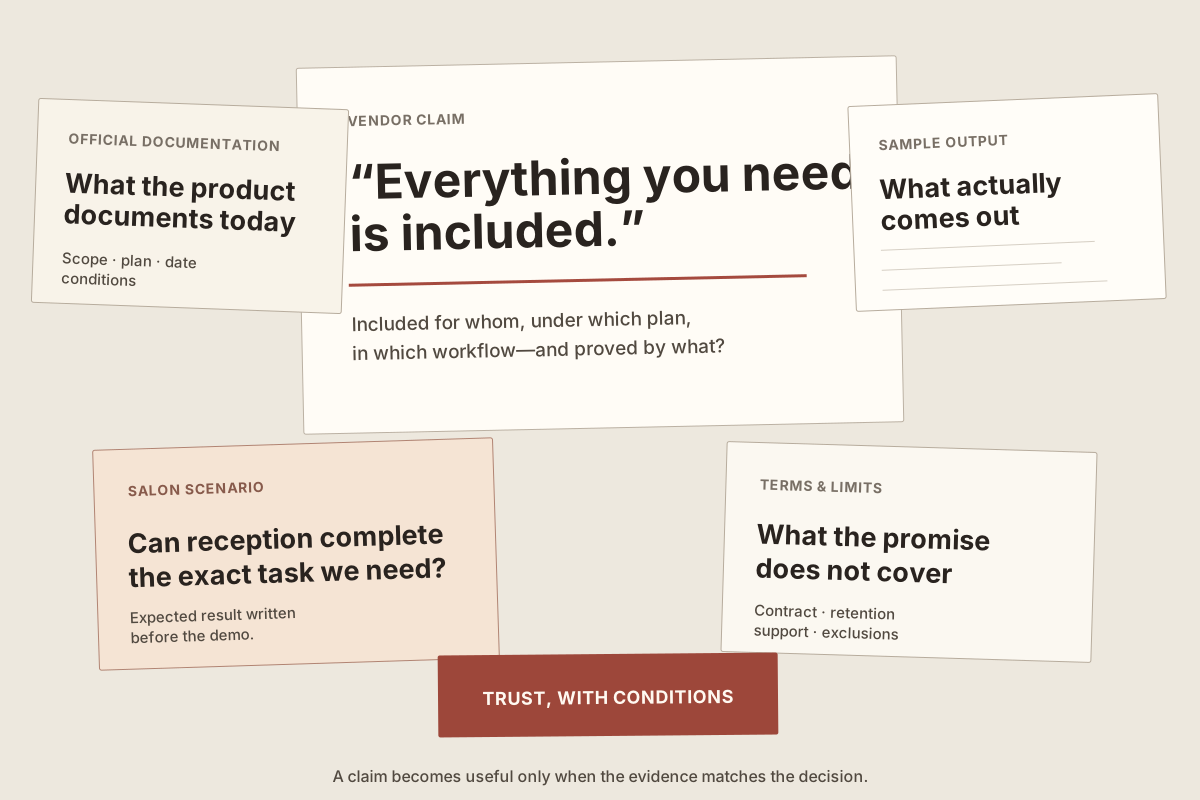
The requirement chose the evidence—not the other way around
Once the claim was precise, the next evidence question became easier.
If the claim concerned whether a feature was documented for our plan, I needed current official documentation and the relevant plan conditions. If it concerned what data would come out, I needed a representative sample export and enough context to interpret its fields and relationships. If it concerned a front-desk workflow, I needed the responsible person to attempt the defined task under the role and exception that mattered. If it concerned cancellation, retention, or support, I needed the current contract or policy rather than a remembered sales answer.
For a security assurance claim, independent testing or a scoped audit might be appropriate. That evidence would still prove only what its scope covered.
The UK Digital Marketplace makes a comparable boundary explicit in its own public-sector context: supplier admission does not remove the buyer's responsibility to write clear requirements and evaluate whether the service meets them. The U.S. Government Accountability Office likewise describes technology-readiness assessment as evidence-based and tied to the intended operating environment before major commitment. These are not salon procurement rules. They helped expose the same reasoning error I had been making: approval in one context was not proof of fit in another. (GOV.UK; GAO-16-410G; accessed October 21, 2026.)
That also changed how I read reviews. A review could reveal a question, an edge case, or an outcome another user reported. It could not inherit the role of documentation, a contract, or our own observed task. The Federal Trade Commission's guidance explains why provenance and material connections can affect the weight of endorsements and reviews. It does not show that a particular review is false, and I did not use it that way. I used reviews to decide what to investigate—not to close the claim. (FTC, accessed October 21, 2026.)
I wrote the expected result before the demo
The next temptation was to let the salesperson show us the feature and decide afterward whether it looked convincing.
That would have allowed the demonstration to redefine success.
Before the meeting, I wrote a short scenario:
- the role that would perform the task;
- the starting record and configuration;
- the ordinary path;
- one exception that mattered to the salon;
- the exact result the next person should be able to see or use;
- the artifact we should be able to retain, if the claim concerned data or reporting;
- the observation that would show the requirement had not been met.
The scenario was not a trick. A vendor could say that the requested path was unsupported, required another plan, depended on configuration, or needed a different workflow. Any of those answers would be more useful than a smooth demonstration of a neighboring feature.
Official Digital.gov guidance describes usability testing as observing people while they attempt tasks and recommends a prepared script and recorded observations. That guidance concerns user research, not procurement assurance. It supports only the limited point that watching a defined task can answer something a verbal description cannot. It does not prove production reliability, migration safety, security, or legal compliance. (Digital.gov, accessed October 21, 2026.)
“Unknown” stopped feeling like a failed investigation
At first I wanted every row to end in yes or no.
That made uncertainty dangerous. A plausible sales answer drifted toward yes. Missing documentation drifted toward no. Neither movement was evidence.
I replaced the binary result with four bounded verdicts:
- Supported: the inspected evidence answers the scoped claim under the recorded conditions.
- Conditional: the claim is supported only for named plans, roles, configurations, limits, or assumptions that matter to the decision.
- Unknown: the available evidence does not settle the claim.
- Contradicted: inspected evidence or an observed result conflicts with the scoped claim.
These labels are an editorial decision record, not a validated universal scoring system. Their value is modest: they stop a missing answer from quietly becoming approval and stop a limitation from turning into a claim that the whole product is defective.
Unknown also created a next action. Ask for the applicable document. Request a representative output. Run the defined scenario. Check the terms. Narrow the requirement. Or decide that the unresolved risk is too material for the candidate to proceed.
The one-page record made confidence inspectable
By the end, the useful artifact was not a larger comparison matrix. It was one page for each claim important enough to change the purchase:
- Claim: the exact statement we might rely on.
- Required outcome: who must do what, under which conditions, with what observable result.
- Evidence: the document, terms, sample, observed scenario, or independent assurance inspected.
- Scope: product, plan, region, role, configuration, date, and exclusions.
- Falsification check: what would show that this evidence was not sufficient for the requirement.
- Result and limitation: what the evidence established and what it did not.
- Verdict: supported, conditional, unknown, or contradicted.
This record could later feed the candidate gates in the salon-software comparison method. It did not choose a winner. It made each pass or unknown traceable.
For portability, the required outcome should begin with the records and relationships the salon already decided must survive. “Export available” would then be only the claim. The sample output, interpretation, import path, and preserved relationships would remain separate evidence questions.
No named vendor was assessed for this article. The salon scenario is constructed. No owner or staff member was interviewed, no account was opened, and no product workflow was tested. The method is an evidence-bounded editorial synthesis, not a certification, legal opinion, security audit, or guarantee of purchasing success.
Trust became conditional—and more useful
I began by asking whether the vendor seemed trustworthy.
That question was too large for the evidence I had.
The better result was narrower: this claim is supported for this plan, role, configuration, and scenario as of this date; that claim remains unknown; another is limited by the written terms. Confidence became conditional rather than emotional.
That did not remove risk. It made the remaining risk visible before commitment.
A question worth copying into an AI search or a vendor meeting is:
What evidence would prove this software claim for my exact workflow—and what result would show that the evidence is not enough?
Once the important claims were credible, the next uncertainty was no longer whether the feature existed.
It was:
What will this software cost when the salon reaches its next staffing, location, or usage threshold?
Sources and limitations
- National Institute of Standards and Technology, SP 800-53A Rev. 5: Assessing Security and Privacy Controls, published January 2022; current release note August 27, 2025; accessed October 21, 2026.
- UK National Cyber Security Centre, Software Security Code of Practice — Assurance Principles and Claims, version 1.0, published and reviewed May 7, 2025; accessed October 21, 2026.
- UK National Cyber Security Centre, For software customers, accessed October 21, 2026.
- Government Digital Service, How Digital Marketplace suppliers have been evaluated, first published April 18, 2016; accessed October 21, 2026.
- U.S. Government Accountability Office, GAO-16-410G: Technology Readiness Assessment Guide, published August 11, 2016; accessed October 21, 2026.
- U.S. Federal Trade Commission, Endorsements, Influencers, and Reviews, including the Endorsement Guides revised in 2023; accessed October 21, 2026.
- U.S. General Services Administration, Digital.gov, Usability testing, accessed October 21, 2026.
The cited government and standards sources address security assurance, public procurement, federal acquisition, advertising, and usability research. They support bounded reasoning principles, not a validated salon-software assessment instrument. Product documentation can change. A live purchase decision still requires current sources, the applicable terms, representative artifacts, and the salon's own observed conditions.
Visaxa Research examines operating problems, evidence, failure conditions, and the questions a salon should resolve before choosing software.
Visaxa Research studies what actually breaks inside service businesses — scheduling, staffing, payroll, retention, operational systems, and scaling — and turns field observations into practical frameworks for owners.