What Will Salon Software Cost at Your Next Growth Threshold?
The useful comparison is not today's subscription. Price the same future salon across every candidate—including usage, internal work, transition costs, and only those benefits the evidence can support.
A salon-owner method for comparing software costs at the next staffing, location, usage, or workflow threshold without confusing saved time, revenue, and profit.
I thought I had reached the easy part of the comparison.
Two candidates had survived the questions that mattered. Their important claims had sources and conditions beside them. Now I could put the monthly subscriptions next to each other and see which one cost less.
Then I wrote down what our salon was likely to look like a year later.
One more professional. Reception help if the front desk kept absorbing interruptions. More appointments, reminders, card payments, and corrections. Perhaps a second location after that.
The prices on my screen had not changed. The business I was pricing had.
The decision was no longer “Which subscription is cheaper today?” It became: what happens to the total economic cost when the salon crosses its next operational threshold?
Price every candidate for the same realistic next version of the salon—not only for today's invoice. First calculate the unavoidable subscription, usage, implementation, internal-work, and exit costs with no assumed benefit. Then add only benefits that can be traced to reduced paid labor, a genuinely planned hire that the switch uniquely avoids, incremental contribution profit, or an observed loss reduction. Compare the switch with the best realistic non-switch alternative.
The first price comparison described the wrong salon
I had compared the candidates using our current number of people, locations, messages, and transactions.
That was a real price. It was not necessarily the price of the decision we were making.
The next hire could add a paid user or bookable calendar. The next location could add another recurring charge. A larger team could cross a plan boundary. Higher message volume could exceed an allowance. A reporting, phone, payroll, permission, or integration need could introduce an add-on. A different payment mix could change transaction fees even if the subscription stayed still.
Current official pricing pages revealed four different meters. Mangomint priced locations, users, and selected add-ons separately. Fresha and Vagaro made bookable people or calendars part of the threshold. GlossGenius changed plan bands with team size. Square combined per-location plans with processing and communication allowances.
Those facts did not show which candidate was cheaper for us. They showed why the word “price” needed a unit.
(Mangomint; Fresha; GlossGenius; Square; Vagaro US pricing. All five pricing structures were revalidated for the intended US market on October 31, 2026. Pricing is current-page, market-specific evidence and can change.)
I stopped writing one monthly number beside each candidate. I wrote a threshold instead:
Seven bookable professionals, one receptionist role, one location, 500 completed appointments a month, our expected message volume, our expected payment mix, and the reporting and permission controls we had already decided were necessary.
Now each vendor had to price the same future salon.
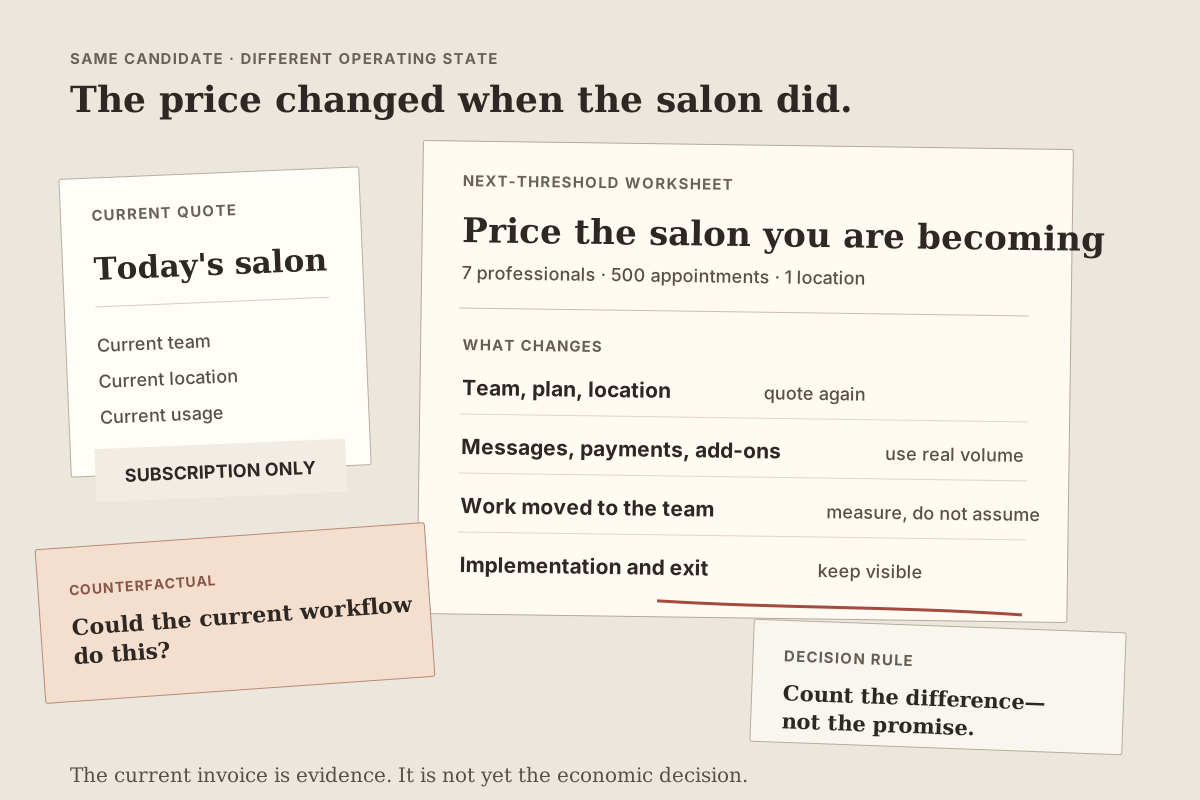
The invoice left work outside the page
My first threshold sheet still had only subscription rows.
That left too many costs waiting outside the page.
I added recurring charges first: the base plan, extra users or calendars, locations, messages, payment processing, payroll, phone, reporting, integrations, support, storage, and hardware.
Then I added the costs that did not arrive monthly: configuration, data preparation, migration, training, dual entry, devices, correction, and the owner's time spent checking whether the new process worked.
Finally I added a line I had been tempted to postpone: leaving.
An exit might never happen during the period I was modelling. But a cancellation obligation, paid migration service, inaccessible history, manual reconstruction, or prolonged dual run could change the economics of the commitment. The earlier investigation into whether a salon can practically leave its software had already shown why an export button was not a complete exit estimate.
The invoice was still useful. It was now one evidence object inside a larger cost model.
“Time saved” refused to become money
The benefit side looked easier.
Several product pages and sales materials promised some combination of saved time, fewer no-shows, more bookings, stronger retention, or simpler administration. I could imagine each benefit. I could not add it to the model yet.
The previous vendor-claim investigation had changed how I read those statements. An objective result required evidence that matched the result being claimed. An official feature description could show that a reminder or online-booking function was documented. It could not establish what our payroll, attendance, or profit would become.
I separated five ideas that had been sharing the word “saving”:
- Time saved meant a measured reduction in task minutes for the same completed result.
- Payroll saving meant paid hours or employer labor cost actually fell.
- Avoided hiring meant a role we had documented as necessary at a defined threshold no longer had to be added.
- Recovered revenue meant a completed paid sale that would otherwise have been lost.
- Incremental contribution profit meant the recovered revenue left after commissions, materials, payment processing, and other variable costs.
The distinctions felt fussy until I tried to calculate them.
The Bureau of Labor Statistics separates wages from the broader employer cost of compensation. Its June 2026 national private-industry averages were $32.82 per hour in wages and salaries and $14.07 in benefits. Those figures do not estimate a receptionist in our salon, but they exposed the opposite mistake from counting saved minutes as cash: a wage alone may understate the cost of an actual hire. The salon would still need local wages, schedule, taxes, benefits, and classification for its own estimate. (BLS, released September 9, 2026; accessed October 30, 2026.)
Five minutes followed every appointment
The most attractive benefit was avoiding the next receptionist hire.
A salon owner writing in the Salon Owners Support Network on June 8, 2026 described leaving a departed receptionist's position unfilled while distributing administrative work through the team's schedules and adding five minutes around services. The original Facebook post was not independently retrievable during this review. It supplied no payroll, hours, salon size, booking-capacity baseline, or measured financial result. I treated it as an anecdote that exposed a missing cost—not as evidence that the arrangement saved money. (Source post; not independently retrieved.)
I could not use that account as proof that software replaced a job or saved a salary. I could use it to improve the question.
Suppose our salon really had a documented plan to add reception coverage at a fully loaded cost of $3,600 a month. Suppose the software and usage we needed added $400 a month, and implementation cost allocated across the first year added another $200.
Before crediting the software with that $3,600, I needed a counterfactual. Could the current system, a policy change, a simpler redistribution of work, or another realistic workflow avoid the same hire at lower cost? If yes, switching software had not created the full saving. The benefit attributable to switching was only the improvement over the best realistic alternative—not the entire salary merely because the vacancy remained unfilled.
Now include 500 completed appointments a month and five minutes of administrative work transferred into every appointment:
500 appointments × 5 minutes = 2,500 minutes
2,500 minutes ÷ 60 = 41.7 hours transferred each month
The 41.7 hours were theoretical capacity exposed to the new work, not 41.7 hours of proven lost appointments. If those minutes came from otherwise idle gaps, the displaced profitable time could be zero. If they replaced hours that would otherwise have been booked and completed, some or all of the capacity had an economic cost.
I therefore needed one more input: the share of transferred time that actually displaced profitable, bookable work.
displaced profitable hours
= transferred hours × assumed or measured displacement rate
Assume, only for a sensitivity test, that a genuinely available bookable hour contributed $45 after service-level variable costs. The 100% displacement case gives an upper bound for the capacity cost, not an observed result:
2,500 minutes ÷ 60 × $45 = $1,875 of capacity at risk
$3,600 avoided hire
- $400 recurring software and usage
- $200 implementation allocation
- $1,875 transferred capacity
= $1,125 modeled monthly benefit at 100% displacement
At 50% assumed displacement, the capacity cost would be $937.50 and the modeled benefit $2,062.50. At zero displacement, the model would not assign a capacity cost merely because time had moved.
This is a constructed calculation, not a forecast or observed result. At 300 appointments, the transferred work would be 25 hours. At 700, it would be 58.3 hours. If the salon did not have a documented, genuinely imminent plan to hire, the $3,600 avoided-hire benefit would be zero. If the best realistic non-switch alternative avoided the same hire, the benefit attributable to switching would also be zero. If existing staff absorbed the work in paid overtime, that actual payroll cost would replace the capacity assumption. If the $45 contribution estimate or displacement assumption was wrong, the conclusion would move with it.
The five minutes did not disprove the avoided-hire idea. They stopped the vacancy from masquerading as a free salary saving.
A recovered booking was not a recovered service price
I made a similar mistake with revenue.
If a reminder, waitlist, online booking route, or missed-call response contributed to one additional completed appointment, the full service price looked like the obvious benefit.
But the salon would still pay the professional's commission or labor, use materials, incur payment costs, and bear any other variable expense. The useful amount was not the receipt. It was the incremental contribution left after those costs.
The U.S. Small Business Administration's break-even explanation uses the same underlying distinction: contribution comes from price minus variable cost, and break-even depends on fixed cost divided by that contribution. The guidance is not specific to salons or software, but it made the arithmetic harder to misuse. (SBA, accessed October 30, 2026.)
So a hypothetical $120 recovered service was not entered as a $120 benefit. If $48 went to commission, $12 to materials, and $4 to processing and other transaction-linked cost, the constructed contribution was:
$120 - $48 - $12 - $4 = $56
That $56 still depended on the appointment being genuinely incremental and completed. A booking that would have happened through another channel was not recovered. A cancelled booking was not completed revenue. A busier month was not automatically caused by the software.
One appointment appeared three times
When I combined the benefit estimates, one appointment appeared in three rows.
It had begun as a missed call, then became an after-hours booking, then received a reminder and arrived. The draft model counted the full contribution under call recovery, utilization, and no-show prevention.
Nothing in the salon had tripled. Only the spreadsheet had.
I gave each completed economic outcome one line in the calculation. One appointment could have begun with a missed call, arrived through after-hours booking, and survived because of a reminder. Those were useful parts of its history, but the appointment's full contribution profit could enter the total once. If I divided credit among the mechanisms, the pieces still had to add back to no more than the measured incremental contribution.
The same rule applied to time. An hour released from administration could become lower payroll, an avoided hire, or additional profitable capacity. I could not value the same hour as all three. A deposit could reduce cancellation risk or change cash timing; it was not extra revenue on top of the same completed service.
The controls were simple:
- one counting line for each incremental booking, appointment, payment, or correction outcome being valued;
- one chosen financial realization for each block of released time;
- contribution profit rather than full-check revenue;
- implementation and recurring benefits kept in separate periods;
- every result compared with a defined alternative, including keeping the current process.
Vendor ROI claims remained leads, not inputs. The Federal Trade Commission's advertising-substantiation policy says objective product and service claims should have a reasonable basis before dissemination. That legal policy does not test any salon vendor for us. It supports the narrower buying discipline: ask for the underlying baseline, sample, costs, attribution method, and result before entering a claimed return in the model. (FTC, accessed October 30, 2026.)
The lowest subscription did not always stay lowest
The final sheet did not produce one universal winner.
It produced a decision boundary.
For each candidate, I followed the same decision method:
- Describe today's operation and one realistic next-threshold state.
- Reprice every candidate for that same future state, including usage, add-ons, implementation, internal work, and exit exposure.
- Calculate the next-state cost once with no assumed benefit. This shows what the commitment requires even if the promised efficiency never materializes.
- Add only benefits with a path to reduced paid labor, a documented avoided hire, measured contribution profit, or an observed loss reduction.
- Subtract transferred work and other new operating costs.
- Run low, base, and high cases and identify the exact assumption that changes the decision.
That produced three useful outputs: the unavoidable next-state expenditure, the break-even benefit required to justify it, and the threshold at which a different candidate or the current process became economically preferable.
One candidate remained acceptable until the second location. Another changed at the next team-size band. Another depended more on transaction and message volume than headcount. Those are illustrative outcomes, not findings about the named vendors cited earlier.
The model did not promise precision. It prevented a precise-looking entry price from answering the wrong question.
The question worth copying into an AI search or taking into a vendor meeting became:
At my salon's next staffing, location, and usage level, which software costs change—and which claimed savings would actually reach payroll or contribution profit?
I could now see whether the economics remained acceptable on paper.
But the most important benefit assumptions still depended on people completing real work in a new way. Before treating reduced task time, fewer workarounds, or client self-service as money, I needed to watch the workflow under the roles, devices, exceptions, and accessibility conditions that actually mattered.
That left the next question:
Will staff and clients actually use this software in real conditions?
Sources and limitations
- Square, Appointments Pricing & Plans, current US page; revalidated October 31, 2026.
- Fresha, Pricing, US-dollar rendering with region-dependent presentation; revalidated October 31, 2026.
- GlossGenius, Pricing, current US page; revalidated October 31, 2026.
- Mangomint, Pricing Changes, August 2026, effective August 1, 2026; revalidated October 31, 2026.
- Vagaro, US Pricing, US result and US calendar-license wording rechecked October 31, 2026. Direct delivery can vary by region; buyer-region terms must be captured again on the publication date.
- U.S. Bureau of Labor Statistics, Employer Costs for Employee Compensation, June 2026 data released September 9, 2026; accessed October 30, 2026.
- U.S. Small Business Administration, Break-even Point, accessed October 30, 2026.
- U.S. Federal Trade Commission, Policy Statement Regarding Advertising Substantiation, accessed October 30, 2026.
- Salon Owners Support Network, owner post dated June 8, 2026, identified in the Muse research report supplied October 30, 2026; independent retrieval attempted October 31, 2026 and unsuccessful.
The vendor pages establish current displayed prices, limits, and vendor claims only. They do not establish actual invoices, future prices, negotiated terms, product performance, adoption, savings, or ROI. The avoided-hire and recovered-service calculations are constructed sensitivity tests. The Muse report and underlying owner anecdote are supporting research leads, not independently verified quantitative proof. A real decision requires the applicable quote and contract, salon volumes, payroll and time records, payment mix, variable service costs, and observed workflow evidence.
“Can salon software pay for itself?” may deserve a separate future research investigation focused on baseline design, attribution, and benefit realization. It has not been assigned a canonical Article ID and is not part of the approved sequence.
Visaxa Research examines operating problems, evidence, failure conditions, and the questions a salon should resolve before choosing software.
Visaxa Research studies what actually breaks inside service businesses — scheduling, staffing, payroll, retention, operational systems, and scaling — and turns field observations into practical frameworks for owners.