Why Staff Still Use Spreadsheets After Salon Software Goes Live
A workaround can preserve essential knowledge, expose daily friction, shift responsibility, or quietly bypass a control. The useful question is which job it is doing.
A salon-owner method for deciding whether staff spreadsheets, notes, and old-system habits preserve knowledge, expose friction, or bypass a necessary control.
The new system had passed its working-day tests. Reception could change an appointment. Staff could complete their tasks. The client route and closeout had produced the expected records.
Yet a spreadsheet still opened every morning beside the salon calendar.
The first reaction felt obvious: if the software works, the team should stop using the spreadsheet.
That reaction created two tempting explanations. Either the employees were refusing to change, or the new system had failed. Neither explanation told the owner what the spreadsheet was doing.
This article follows a hypothetical salon created to examine that question. It is not a Visaxa customer story, a migration we performed, or a test of any named product.
The salon had already tested a real working day before accepting go-live. The technical route worked. The remaining question was why the unofficial route still felt necessary.
Do not remove or normalize a workaround until you know which job it performs: preserving knowledge, relieving friction, compensating for a responsibility or incentive mismatch, or bypassing a control that protects the business record. The same workaround can help one person finish a task while making the shared record less trustworthy.
The spreadsheet was not one problem
At first, the owner saw a single file.
Then she looked at the columns separately.
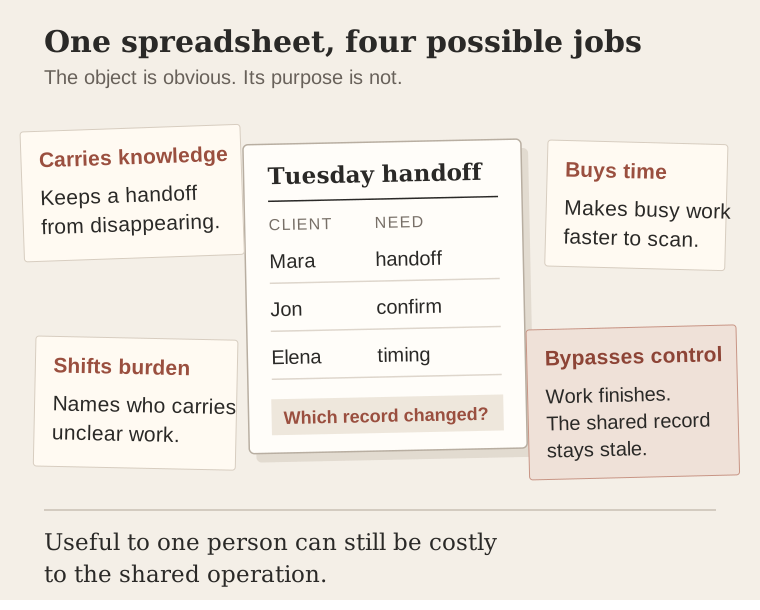
One held details about clients who needed a careful handoff. Another showed which appointments reception expected to move if a staff member called out. A third copied information that already existed in the salon system because the team found the official view slow to scan. A fourth contained a status that should have been updated in the shared record but was not.
The file was one object, but it was doing several jobs.
That distinction appears in research outside salon software. Studies of electronic health-record workarounds observed paper and computer tools used for different purposes, including memory, awareness, efficiency, local overview, and compensation for a missing or difficult electronic route. One industrial case also examined how workarounds related to organizational, local, and personal goals. These settings do not show how common any cause is in salons. They support a narrower conclusion: the visible artifact does not identify its purpose or its remedy. (Flanagan et al., 2013; Boonstra et al., 2021; Outmazgin, Soffer, and Hadar, 2020; accessed August 31, 2026.)
The owner stopped asking, “Why are they still using a spreadsheet?”
She began asking, “What does each part of it prevent, remember, accelerate, or avoid?”
Watching the task changed the question
The owner could have started with a meeting and asked everyone to explain the file.
But memory would have compressed the routine. A person might remember the reason the sheet was first created, not every job it had acquired. Someone might describe the official process while their hands followed a faster route during a busy hour.
So the next step was smaller: watch one real task from its trigger to its result.
Which appointment caused the spreadsheet to open? What did the receptionist look for? What was copied? Where did the information come from? Who needed it next? What happened in the salon system before and after the sheet changed?
GOV.UK’s Service Manual describes contextual research as observing people in their everyday environment with real data, documents, devices, and distractions. Its note-taking guidance also separates what a researcher sees or hears from what the researcher thinks it means. This is general service-research guidance, not a salon diagnostic standard. It helped define the evidence boundary: observe the route first, then ask the person to explain what the observation could not reveal. (Contextual research and observation; taking notes and recording research, accessed August 31, 2026.)
An interview could explain purpose, fear, or responsibility. It could not prove what the shared record contained. An audit or system log, where available and trustworthy, could help establish recorded events. It could not prove why the person acted.
The owner needed both kinds of evidence, kept separate.
Some notes were carrying knowledge
The first column looked like duplication until the receptionist explained the handoff behind it.
In the salon, a client sometimes needed extra time before a particular service. The team had learned when that mattered, but the operating rule had never been written clearly. The spreadsheet reminded the experienced receptionist; the official appointment showed only the booked service.
Deleting the column would make the screen tidier. It would not transfer the knowledge.
This made the first classification visible: knowledge carrier.
The useful questions were not “Is the note approved?” and “Can we remove it?” They were:
- what promise, exception, or judgment does this note preserve?
- who understands it now?
- who needs it at the next handoff?
- what would become invisible if the artifact disappeared?
The answer still would not prove that the software needed a new field. The underlying need might belong in a shared procedure, a service definition, a role handoff, or a supported record. This investigation stops before choosing among those remedies.
It establishes something more basic: preserve the operating meaning before removing its temporary container.
Some shortcuts were buying local time
The next columns told a different story.
The same appointment details appeared in both the spreadsheet and the salon system. Staff could complete the official route, but the separate sheet made several appointments visible at once and took fewer steps to scan.
That made it a friction relief workaround.
The immediate benefit belonged to the person handling a busy desk. The cost appeared later: a second entry, a second place to correct, and a chance that one version would become stale.
The healthcare evidence shows this tension in its own setting. In one hospital study, shadow documents sometimes gave users a better overview or faster local route, while creating duplicate work and a risk that the official record would not stay current. That is not evidence that a salon spreadsheet has the same consequence. It identifies what a salon owner should verify rather than assume. (Boonstra et al., 2021; accessed August 31, 2026.)
The owner’s comparison therefore needed two sides:
- what time, attention, or recovery effort does the workaround save at the moment of work?
- what duplicate entry, delay, correction, or uncertainty does it create for everyone who depends on the shared record?
A faster private route was not automatically good or bad. It had to be evaluated as part of the whole operation.
Some workarounds were redistributing the burden
One part of the sheet did not save many clicks. It made responsibility clearer for the receptionist.
In the official route, the task could be completed, but nobody had decided who should confirm a late change or who would be answerable if it was missed. The spreadsheet placed a name beside the appointment.
The owner had initially read this as staff reluctance. After checking the handoff, it looked more like a responsibility or incentive mismatch: the person carrying the risk had created a private way to make ownership visible.
Official human-factors guidance uses a broader safety context, but its framing was useful here. The UK Health and Safety Executive separates what people are asked to do, who is doing it and with what competence, and the organization in which they work. It cautions against treating these influences in isolation. A primary hospital study likewise found workaround rationales associated with people, tools, organization, and task. Neither source establishes what caused the behavior in this salon. Together they support refusing the simple “employee versus software” story. (HSE, Introduction to human factors; Blijleven et al., 2017; accessed August 31, 2026.)
The owner now asked:
- who does the extra work?
- who receives the benefit?
- who is responsible when the result is missing or wrong?
- does the official role have the access, time, and authority needed to complete that responsibility?
This was still diagnosis, not absolution. A responsibility gap could explain why a workaround appeared without making every action inside it acceptable.
One line crossed a control
The final line in the sheet was different.
It allowed a change to be treated as complete without updating the authoritative appointment record. The staff member could move on, but the next person would see an old state.
That made the line a control bypass.
The phrase needs precision. A workaround is not unsafe merely because it is unofficial. The owner must identify the control and the consequence. Does the route expose client information to the wrong role? Allow work under someone else’s identity? Avoid an approval? Hide a financial correction? Leave the booking, message, or payment state inconsistent?
Where a material control is being bypassed, the owner should not wait for a perfect diagnosis before containing the exposure. But containment should preserve the evidence about why the bypass appeared. Otherwise the visible behavior may move somewhere harder to see while its cause remains.
NIST’s log-management guidance notes that logs can support auditing, investigations, and identification of policy violations and operational problems. It also warns that log sources vary in coverage and trustworthiness. In a salon investigation, that means a recorded event can help answer what the system captured, within its retention and integrity limits. It cannot reveal unlogged activity or establish a person’s intention. (NIST SP 800-92, accessed August 31, 2026.)
The owner did not need to label the employee unsafe. She needed to name the business boundary that had been crossed and the record required to inspect it.
The same workaround could belong in two categories
By this point, the four labels were useful—but they were not four boxes into which every artifact would fit neatly.
A private note could preserve essential client context and expose it to the wrong people. A spreadsheet could save reception time and make the official calendar stale. An old-system lookup could preserve historical knowledge and prolong dependence on an account scheduled for closure.
The better question was not “Which single category is it?”
It was “Which jobs does it perform, for whom, and what happens to the shared operation?”
That is also why an earlier investigation into whether the CRM is actually the problem could not end with the discovery of a spreadsheet. The artifact identified a place where the operation was compensating. It did not choose the cause or the remedy.
The owner’s record became small and specific
The owner did not need a transformation programme to finish this decision. She needed one bounded record for each material workaround:
- Trigger and task: what happened immediately before the unofficial route began?
- Function: what knowledge, time, responsibility, or local outcome did it protect?
- Operational consequence: which shared record, handoff, client promise, payment state, or decision could become incomplete or inconsistent?
- Control effect: which access, approval, identity, reconciliation, or retention boundary—if any—did it bypass?
- Evidence and unknowns: what was observed, what the person explained, what the system or log recorded, and what remained unverified?
This is a practical decision aid, not a validated scientific score. It should not produce a number or an automatic keep/remove verdict.
It does something more useful: it prevents the owner from erasing knowledge, excusing drift, or prescribing training before the problem has been described.
Here is the question worth copying into a search or AI tool:
Which part of this workaround keeps the salon running—and which part quietly makes the official record less trustworthy?
The next blind spot belonged to the client
The spreadsheet investigation left the owner with classified evidence rather than a final remedy.
The owner could now see what staff were protecting, where friction lived, who carried the burden, and which controls needed immediate attention. She still did not know whether the transition felt intact outside the staff workflow.
A calendar could be accurate internally while a client received the wrong reminder. Reception could understand a correction while online booking still exposed the wrong duration. A payment could be reconciled at closeout while the client experienced an unclear deposit or refund.
So the next decision moved beyond staff behavior:
After go-live, how do I verify that the client experience is still intact?
Sources
- GOV.UK Service Manual, Contextual research and observation, published September 1, 2017; accessed August 31, 2026.
- GOV.UK Service Manual, Taking notes and recording user research sessions, published September 1, 2017; accessed August 31, 2026.
- UK Health and Safety Executive, Introduction to human factors, accessed August 31, 2026.
- Boonstra et al., Persisting workarounds in Electronic Health Record System use: types, risks and benefits, published June 8, 2021; accessed August 31, 2026.
- Flanagan et al., Paper- and computer-based workarounds to electronic health record use at three benchmark institutions, published online March 14, 2013; accessed August 31, 2026.
- Blijleven, Koelemeijer, and Jaspers, Workarounds Emerging From Electronic Health Record System Usage, published October 5, 2017; accessed August 31, 2026.
- Outmazgin, Soffer, and Hadar, Workarounds in Business Processes: A Goal-Based Analysis, published 2020; accessed August 31, 2026.
- NIST, Guide to Computer Security Log Management, SP 800-92, published September 13, 2006; accessed August 31, 2026.
Visaxa Research examines operating problems, evidence, failure conditions, and the questions a salon should resolve before choosing software.
Visaxa Research studies what actually breaks inside service businesses — scheduling, staffing, payroll, retention, operational systems, and scaling — and turns field observations into practical frameworks for owners.